
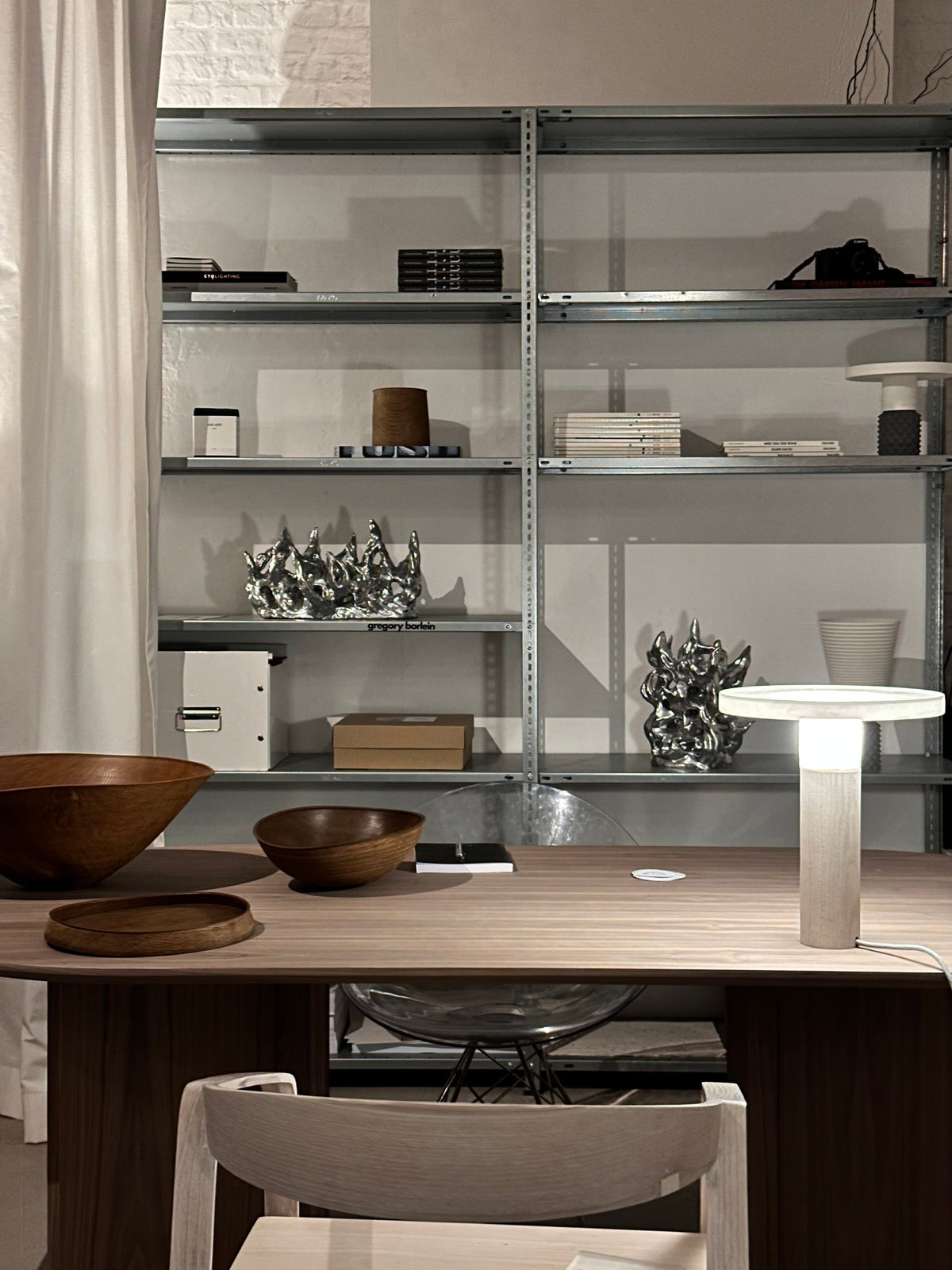
collectible design is a market term, but the thing it points at is simple: an object whose maker is accountable for it. someone decided its form, chose its material, and put their name on the result — usually in a small number, sometimes only once. that holds for a cup exactly as it holds for a console; the price reflects material, making and edition size — it is not a ranking of worth. a collection starts the moment you buy your first object because of who made it and how — not because it matched a sofa.
unique, numbered, made to order
maria cepissakova turns porcelain by hand, without molds — each cup comes off the wheel as a form of its own. that is why her kontrapunkt colorado cups (€75 for the smallest size) carry no edition number: a unique piece needs none. her kontrapunkt platinum cups (from €135) show the second form — a numbered edition, fired three times and covered in platinum, made for acapulco and shown at salone del mobile 2024 and at the ad rosewood opening in munich: exhibition provenance, attached to a cup, the same mechanism collectors pay for at any scale. the third form, made to order, runs through much of the shop's italian range below: pieces produced only when someone commits, with the production time stated in days. three forms, three different promises — knowing which one you are buying is most of what expertise means.
 kontrapunkt colorado, maria cepissakova — hand-turned porcelain, no molds, each cup a unique piece.
one sheet of aluminium, 218 objects
denis santachiara — a name italian design has known since the 1980s — laser-cut a single aluminium sheet, 1.5 by 3 metres, into 363 pieces that form 218 products across 27 themes. the parent work, big nesting, is in the shop at €9,800. his centrotavola (€225), a spiral centerpiece shaped by hand into three dimensions, is cut from that same sheet — you are not buying a smaller idea, you are buying a fragment of the same work. each piece is made to order to avoid waste, colours fall as they fall.
 centrotavola, denis santachiara — a hand-shaped fragment of the big nesting sheet.
the logic of drawing serious work from a single sheet of metal runs through the whole italian range, carried by designers with decades of exhibited work. sebastian bergne's hands up tray (€156) is one piece of reflective laser-cut steel, its handles cut directly from the sheet itself. ronen kadushin's flat knot bowl (€195) is cut from a single sheet of steel and bent into shape by hand. alberto meda's omaggio a donald judd (€292) — four anodized aluminium shelves, delivered flat, folded on arrival — says its argument in the title: an homage to judd's reduction. and santachiara's gentile tray (€195) hides sixteen petals that detach into coasters — wit as a design position, not a gimmick.
ask why it looks the way it does
which points to the habit worth forming early: expect a piece to answer the question "why this form?" with something you can repeat. studio von schoenebeck's tetris candle holder (from €380) is finished in shou sugi ban, the centuries-old japanese technique of deliberately burning wood. the decision has a traceable origin: a chandelier the studio built for the kocherlball, where candle flames began to char the raw wooden prototype — and the studio kept the effect instead of correcting it, in black and in red. an object that answers with a technique, a history or a position is collectible. an object that answers with a trend is decoration. the price tag doesn't make that distinction — the answer does.
 tetris, studio von schoenebeck — shou sugi ban, kept from an accident on a kocherlball chandelier.
read the listing like a collector
the listing itself tells you how serious the seller is. materials named precisely. dimensions. the edition status, stated plainly. the production time in days, if it's made to order. and the logistics of where the piece actually is — in a consignment gallery it stays in the maker's studio and ships from there once sold, a structure we've documented from the designer's side in how consignment with a gallery actually works. read a few listings this way and the difference between a collectible object and a decorated one becomes visible fast — long before you spend anything.
a first piece does one thing no amount of reading does: it teaches you what you actually want to live with. buy one object you can defend — unique, numbered, or made to order — and the second purchase will already be more precise. the under €300 collection currently holds the pieces that qualify.
we write about pieces, designers and how collecting works once or twice a month — the newsletter signup is at the bottom of this page.