
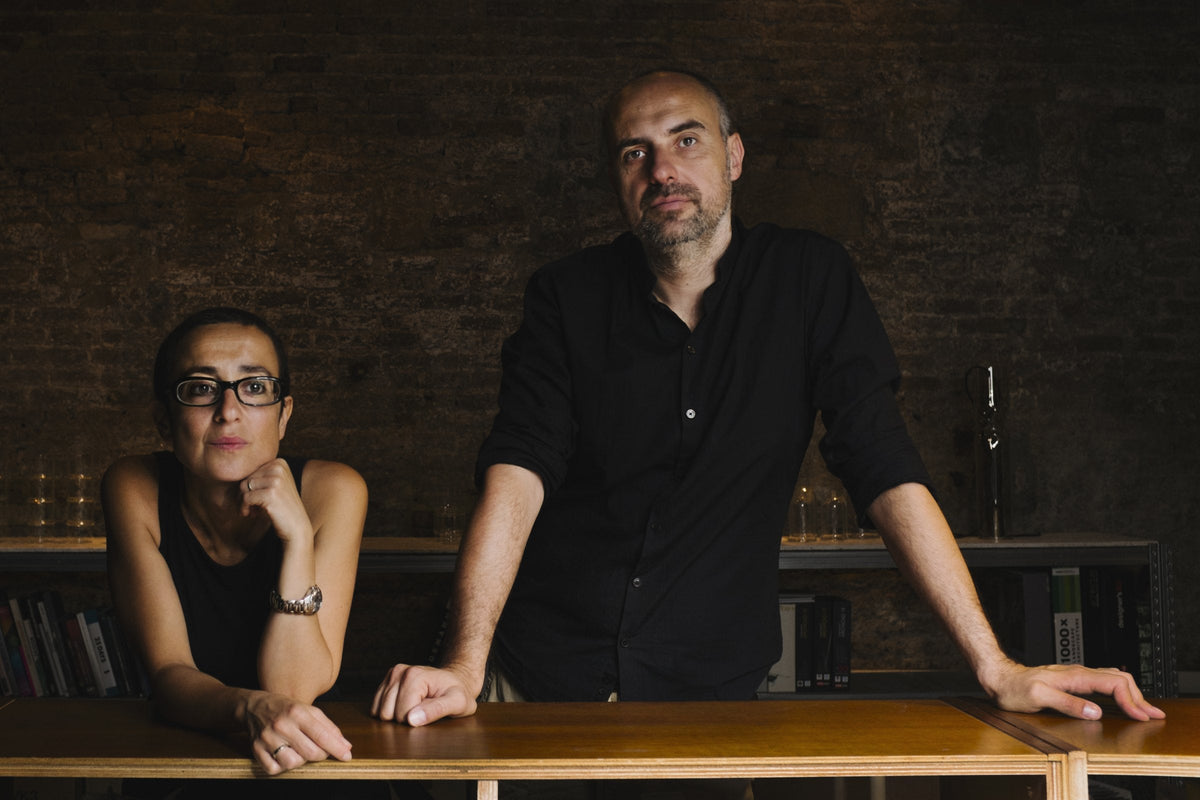
venice and glass go together so easily that the pairing hides the choices inside it. kanz, the studio of antonella maione and mauro cazzaro, makes one of them visible: every piece we show from them is borosilicate glass, clear, made by hand in venice, and designed by a studio that approaches buildings and objects with the same method.
a studio that works at every scale
maione and cazzaro founded kanz in venice in 2014. the studio sits in dorsoduro, on calle lunga san barnaba, and its work runs from the restoration of residential architecture through commercial interiors and temporary design to product design. they describe the common thread themselves: whether the object is a building or a product, material or conceptual, they approach it with the same experimental method and the same attention to detail and to what a technique or a material can do.
in product design that method has a particular shape. next to collaborations with companies in accessories and lighting, kanz combines its own design work with a close collaboration with local artisan workshops, and produces independently. the borosilicate pieces are blown by soffieria s.a.s.; the result is a small, non-serial production in which no two pieces come out quite the same.
the light of a chandelier, in a bottle
calabaza is the clearest example of how kanz reads venice. the name is spanish for pumpkin, and for flask. the bottle is drawn from archetypal forms of the natural world, and its blown volutes and striped glass catch the light the way the ornaments of venetian chandeliers do. it holds a litre and a half, and in clear glass it is food-safe.
colour from below
the iride series works with a single gesture. the bottom of each glass is painted by hand, with a brush, and the glass does the rest: refraction carries the colour up through the clear body to the surface, so a tumbler seems tinted all the way through. the iride tumblers come in sets of six, from shot to longdrink; the iride pitcher and the iride bottle, whose painted cap doubles as a glass, hold 75 cl each. because the colour is applied by hand, it can shift over time with the character of the material.
a mistake that holds
mistake takes deformation as its subject: the glass is pinched into one or more bottlenecks, and still it holds a tea light safely, so the flame seems to hang in space. deformations, imperfections, mistakes, but not wrong, in the studio's words. tharros is a candle holder with brushed colour, and flame an oil lamp in clear glass.
for the table
the rest of the pieces are made for daily use. take is clear glass for the table, in pairs for water, wine and whisky and as carafes of 50 and 75 cl. bebo is a cruet for oil or vinegar, aqua a small architecture for cut flowers that supports the stems rather than holding them, and smoke an incense holder with the hole for the stick set in green.
what to look for
with these pieces, two things are worth a closer look. the small variations: a slightly different curve, size or shade is the mark of a piece made by hand, not a flaw. and the colour, where there is any: on iride and tharros it is brushed on by hand, so each piece carries its own.
kanz has shown at collect at the saatchi gallery in london, at maison & objet in paris, at the london design festival and at the venice glass week. all pieces by kanz on spazio: kanz.
photos of the studio: marco cappelletti and anna mainenti.