
For Robert Megel in Dresden, Cork Belongs Exactly Where the Hands Touch It
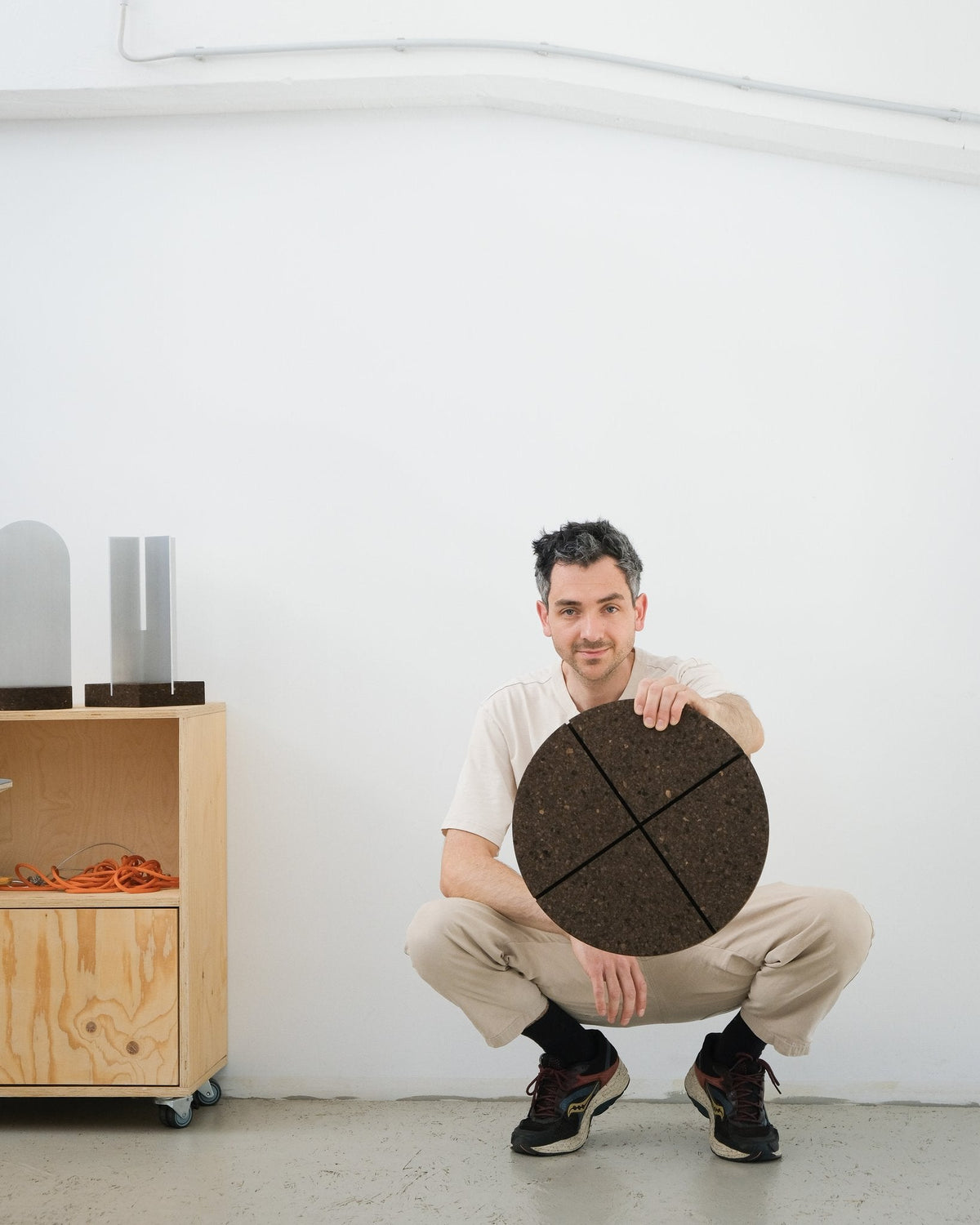
Two cork stools have lived with Robert Megel since his time at Herzog & de Meuron in Basel. While he was there, the Serpentine Gallery Pavilion that the architects designed with Ai Weiwei was newly built, and the stools were developed for it. Since then, he says, he has wanted to work with cork himself and to keep testing it. He has been doing that in Dresden, where he is based as a designer, and the result is 'Cork X', a collection of furniture and objects in Portuguese natural cork and aluminium that he has kept developing since 2023.
Megel studied architecture at the Technical University of Dresden and at the University of Porto, and besides Herzog & de Meuron he worked for Rohdecan Architekten in Dresden. Today he concentrates on furniture and objects of his own, and he places his work at the intersection of architecture, furniture and product design. His cork comes from Portugal, where he spent part of his studies, but he came to it as a material for design in Basel. As he describes it, cork can be formed without limit and has no preferred direction. The architects there shaped his thinking as a designer, he says. “Testing materials and their inherent limits, and sometimes pushing those limits back, is one of the architects' principles of design,” he writes, “one that fascinates me to this day.”
His own testing began with yoga blocks and a few questions: “How stable, how load-bearing is cork? Can something be inserted into cork with a force fit, like a kind of inverted cork?” In the neck of a bottle, the cork is what gets pushed in, and it holds because it presses back against the glass. Megel wanted to know whether cork could do the holding instead. The trials he ran with different materials and thicknesses laid the groundwork for 'Cork X'.

In 'Cork X' the two materials have different jobs. Megel calls them contrary and gives the aluminium the role of a cool supporting structure. The cork is the warm, soft material that can be touched, and it makes the furniture both sturdy and pleasant to use. It is this contrast, he says, that interests him. The aluminium parts are laser-cut by a manufacturer, and Megel satin-finishes them by hand. His care notes for the side table describe its cork as unsealed and say the raw aluminium will take on a patina over time. (The bench, the side table and the stool from 'Cork X' are on spazio.)
“Cork belongs exactly where the hands touch it.”
In Copenhagen, during 3daysofdesign, the stool stood in a room called The Perfectionist in Adorno's exhibition Persona. In Dresden, in the summer of 2025, it was part of a pop-up exhibition at the Japanisches Palais, held with the Kunstgewerbemuseum of the Dresden State Art Collections and titled Bitte nicht setzen! (please do not sit).

His own workshop is in Dresden too, and the days there, he writes, are “sadly always far too short”. He works the cork himself, the classic way, like wood in a woodworking shop, and tries to keep the metalwork in a separate space, because the two materials give off different chips and dust. Most pieces are made once they have been ordered. “Working in the workshop is a wonderful symbol of the fact that things take time,” he says. “Our lives are so digital that I tend to lose a natural sense of time. For me, a day in the workshop is like a walk in the forest: grounding.”
What he is working on now is new to him. He is developing a system of stackable storage boxes that customers can fold themselves, and for it he is learning to bend metal: how different alloys behave in the bend, and what other forms the edge of a fold can take.

We asked him which of his pieces he would keep for himself, and he chose a yoga block, the object his testing began with. He recently built a small series of them in his workshop, which he says gave him great fulfilment, and the block is now part of 'Cork X'. “I once said of my furniture that cork belongs exactly where the hands touch it,” says Megel. That applies above all, he adds, to “this little helper”, and cork “simply feels so good to the touch”. “I would like to keep one of the blocks,” he says, “but otherwise I am happy about every block that sells, because I know it will bring someone joy in their yoga practice.”
Robert Megel answered our questions in writing, in German; the quotes are our translation. Photographs: Robert Megel.


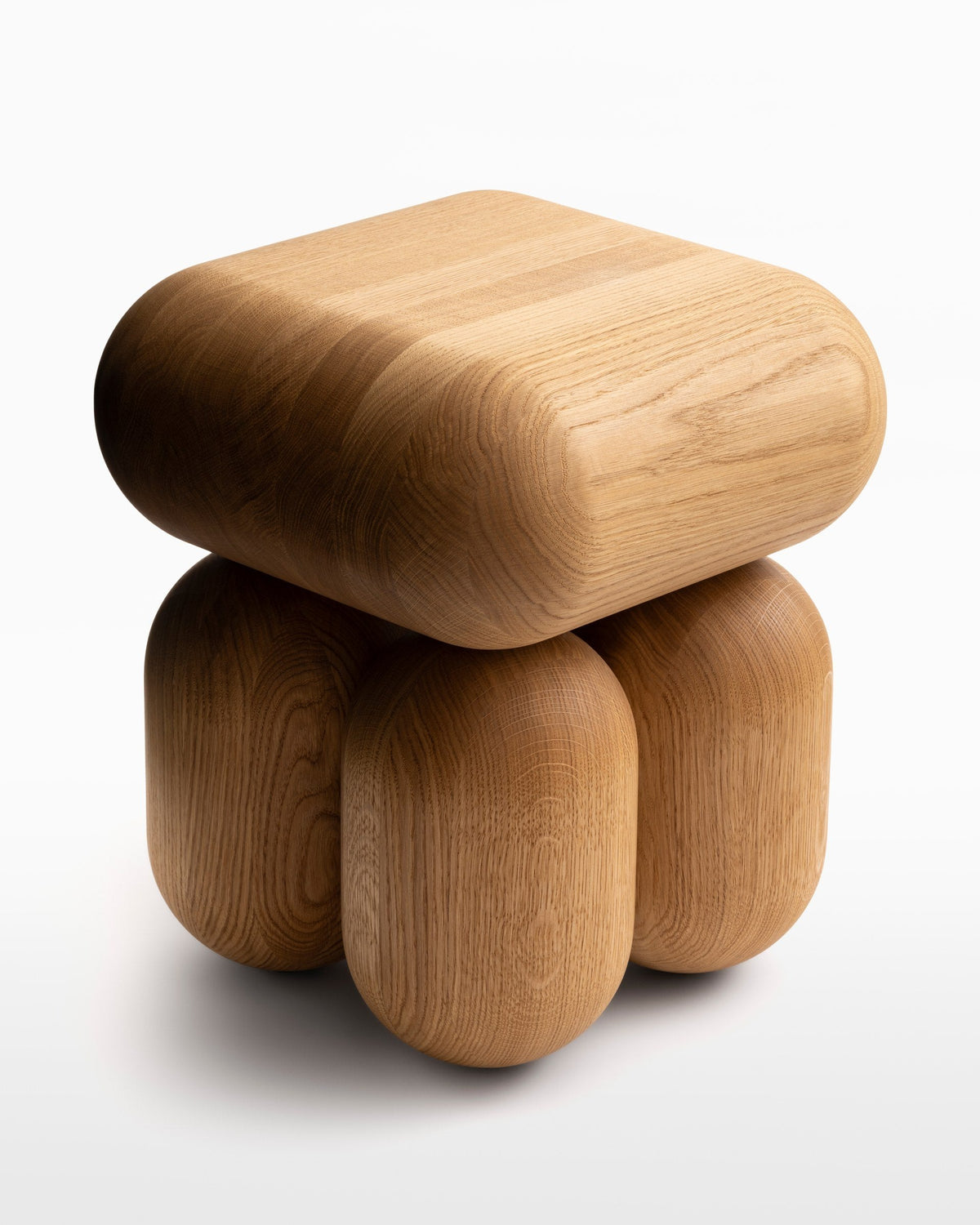
At New Facettes in Berlin, Max Kellermann and Sebastian Labis Make Solid Wood Look Almost Unreal
Two architects in Berlin make a stool in solid ash or oak that could pass for a rendering. A portrait of New Facettes from the first...

In Donostia, Joshua Linacisoro Welds an Incense Holder to Keep His Hands in Practice
Joshua Linacisoro works between Donostia and Barcelona, on objects made for small daily ceremonies. A portrait from the first issue of our magazine.

In Studio von Schoenebeck's Chairs Named After Bulgakov's Lovers, Margarita Is the Sturdier One
Magdalena Shterianova's favourite novel became a pair of chairs in raw aluminium. How Studio von Schoenebeck in Munich builds its stories into aluminium and charred beech....