
before working with clay, berlin-based artist and designer barbara jenner studied tapestry at the academy of fine arts vienna. the connection between weaving and ceramics might not be immediately obvious, but both involve repetition, rhythm and the gradual building of a surface. a small change can alter an entire pattern.
this idea runs through duotone, a series of stoneware vessels made with contrasting clays. black marks form lines, gather into patterns and then seem to lose their order again. in duotone #6 — lost pattern, one edge, the marks are scattered across a pale surface, while duotone #10 — beige & black, marbled takes a different direction, with fine black marbling running across the form.
the question behind the series is simple: at what point does repetition become a pattern, and when does that pattern begin to fall apart?
starting with a familiar shape
jenner founded atelier von ehren in berlin in 2022. she works mainly with stoneware, making individual pieces that sit somewhere between functional vessels and sculpture.
most begin with a simple geometric form — a cylinder, a sphere or a cuboid. from there, the proportions change, edges appear or disappear, and the surface develops its own rhythm. the original shape often remains recognisable, but it is no longer quite what you expect.
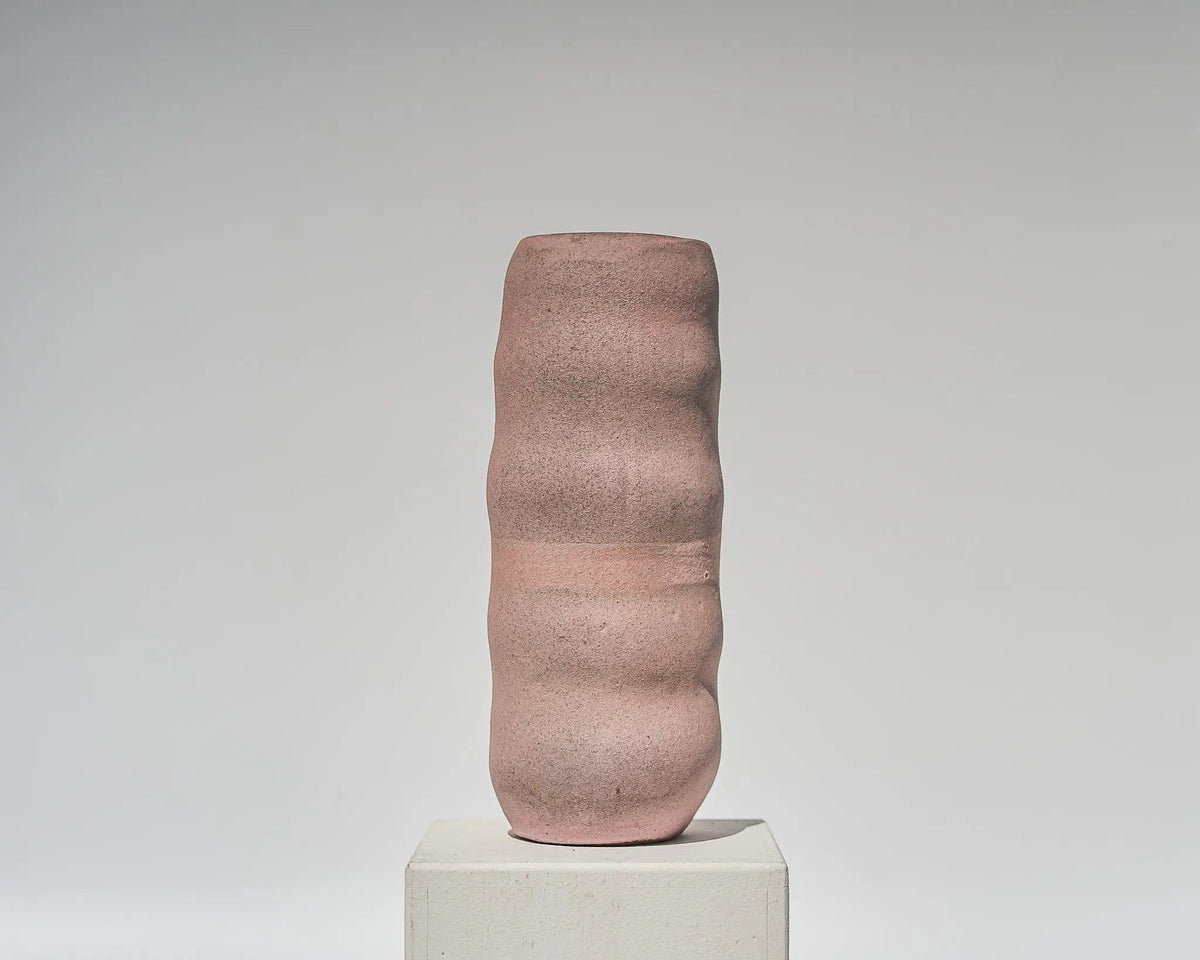
round & round takes the cylinder as its starting point. inspired by joni mitchell's the circle game, the series deals with repetition and change. lines, waves and grooves move around the surface, sometimes following the shape, sometimes interrupting it. in the circle turns, a wave travels around the body of a matte rosé vase.
the pieces can hold flowers, but they don't depend on them. they work just as well as objects in their own right.
can you see weight?
cutting weight approaches the vessel from another direction. these are substantial bowls, often with an inner shape that develops independently of the outside. a thick outer wall might suggest a solid mass, while the interior tells a different story.
the series also raises a question that is surprisingly difficult to answer: can you actually tell how heavy something is just by looking at it?
in cutting weight — green, straight edge, the grooved surface and broad, rounded body give the bowl a sense of weight even before it is lifted.
a little out of proportion
schattenfänger takes its name from the german words for catching shadows. the objects are slightly stretched, unusually long or just a little off balance. what happens if one part of a familiar shape is extended further than expected?
the resulting forms are difficult to pin down to a single view. seen from one side, an object might appear almost symmetrical; from another, its proportions seem entirely different. and then there are the shadows, which stretch and distort the forms even further.
the schattenfänger — conical, beige shows this particularly well, with its asymmetric body and narrowing opening.
objects in a room
jenner also holds a phd in art history. her studio takes its name from her great-grandfather, julius von ehren (1864–1944), a hamburg painter who often found his subjects in ordinary scenes of everyday life.
across her different series, jenner keeps returning to a few basic questions about form, proportion and perception. how much can a familiar shape change before we see it as something else? how does a surface affect the way we read an object? and what happens when that object is placed in a room?
a vase is a useful starting point. it has a recognisable shape and an obvious function. but it can also do something without being used: change the way light falls on a surface, interrupt a line, or make us look at a familiar space a little differently.
explore all works by atelier von ehren at spazio: atelier von ehren.