
Kiril Georgiev, an Architect by Training, Lets the Broken Glass Speak
“You push a material too hard and it breaks. You work with it too slow and it disfigures beyond repair.”
That is Kiril Georgiev, and it sounds like a warning, a surprising one, since a whole branch of his work begins with glass that is already broken.
Georgiev is based in Sofia, in Bulgaria, where his family is from. He studied in London, taking a bachelor's and a master's degree in architecture at the University of Westminster and The London School of Architecture, with a semester at Unitec in New Zealand that focused on design with sustainable practices and the natural environment. As an architect he worked on private and public housing and on civic buildings, for Goldsmith Architects in Rotterdam, Bruther in Paris and Delve Architects in London. His own practice carries his name with the surname first, Georgiev Kiril, and he sees it as floating “within the fields of architecture, art, theory, research, and other phenomena.” It takes on architecture and interiors to commission and makes design pieces “rooted in traditional craft.” (Ten of them are on spazio, three lamps in glass and seven in steel, each made to order.)
The intention of all this, he says, is “to distill (much like in cooking or perfume making) new relations between separate things that originally had nothing to do with each other.” He speaks of adapting to new techniques while staying “as true as possible” to traditional ones, and of working “with people that have spent lifetimes learning their crafts.” The idea of new relations returns, almost word for word, when he turns to the glass.
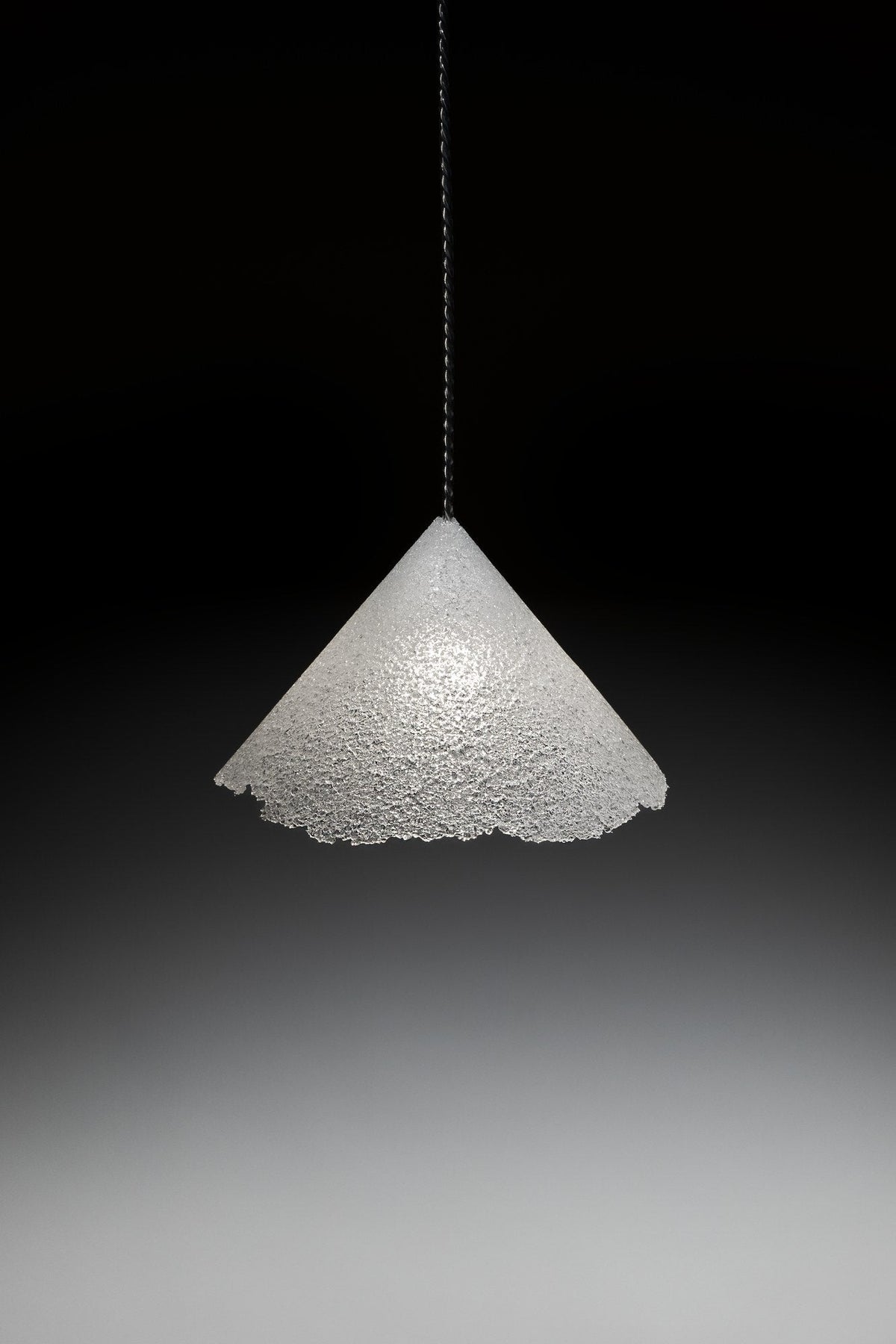
That branch of his work is pâte de verre, French for glass paste. Nothing is blown: crushed glass is packed into a mould and fused in a kiln, a technique with ancient roots that French glassmakers revived at the end of the nineteenth century. For some pieces he names a second technique next to the casting: slumping, in which glass is softened over a mould and shaped by gravity. The raw material is frit, glass broken into grains of different sizes and melted at different temperatures for different textures and transparencies. Every piece is made by hand and comes out with variations of its own.
The forms are kept “as distilled as possible” (that word again) “in order to let the broken glass be the dominant character/expression.” What drove the collection, he goes on, was “the capacity of broken fragments to form new constellations, not from restoring a whole but from establishing new relationships between parts.” Rupture, in his words, becomes “the condition for new identities rather than a loss to be repaired.” The three pendants we carry are in this glass: 'Pendant Cone S' and 'Pendant Cone M', from the Krystallos series (krystallos is the ancient Greek word for ice, and the word crystal comes from it), and 'Pendant Vesica'.

With the steel lamps the idea of relations comes up a third time: they are, as he puts it, “imagined around relations created by lines, circles and points of light.” The steel is welded and polished by hand, either brushed or to a mirror finish, and for 'Floor Lamp No. 1' he adds that no “harmful surface coatings, plating, or artificial finishes” are used. Four of the brushed lamps, 'Hanging Lamp No. 1' among them, belong to a series called Two Circles. The two mirror-polished desk lamps, 'Desk Lamp No. 3 Vesica' and 'Desk Lamp No. 4', belong to the Vesica Piscis series; in geometry, the vesica piscis is the almond shape that appears where two equal circles overlap, each passing through the other's centre. The name turns up in the glass too, in 'Pendant Vesica'. The fifth brushed piece, 'Picture Light Asta', is made for whatever hangs on the wall below it.


pendant vesica
$1,958.00georgiev kiril


pendant cone m
$1,612.00georgiev kiril


picture light asta
$1,030.00georgiev kiril


desk lamp no. 4
$1,723.00georgiev kiril


desk lamp no. 3 vesica
$1,612.00georgiev kiril


wall lamp no. 1
$1,723.00georgiev kiril


floor lamp no. 1
$1,377.00georgiev kiril


desk lamp no. 1
$951.00georgiev kiril

In Donostia, Joshua Linacisoro Welds an Incense Holder to Keep His Hands in Practice
Joshua Linacisoro works between Donostia and Barcelona, on objects made for small daily ceremonies. A portrait from the first issue of our magazine.

In Studio von Schoenebeck's Chairs Named After Bulgakov's Lovers, Margarita Is the Sturdier One
Magdalena Shterianova's favourite novel became a pair of chairs in raw aluminium. How Studio von Schoenebeck in Munich builds its stories into aluminium and charred beech....

Mina Wright Came to Clay From Painting, and Named a Vase After a Rococo Dress
Mina Wright came to clay from painting. In Barcelona she builds and paints her vases by hand, and has named one of them after a rococo...