
In Studio von Schoenebeck's Chairs Named After Bulgakov's Lovers, Margarita Is the Sturdier One

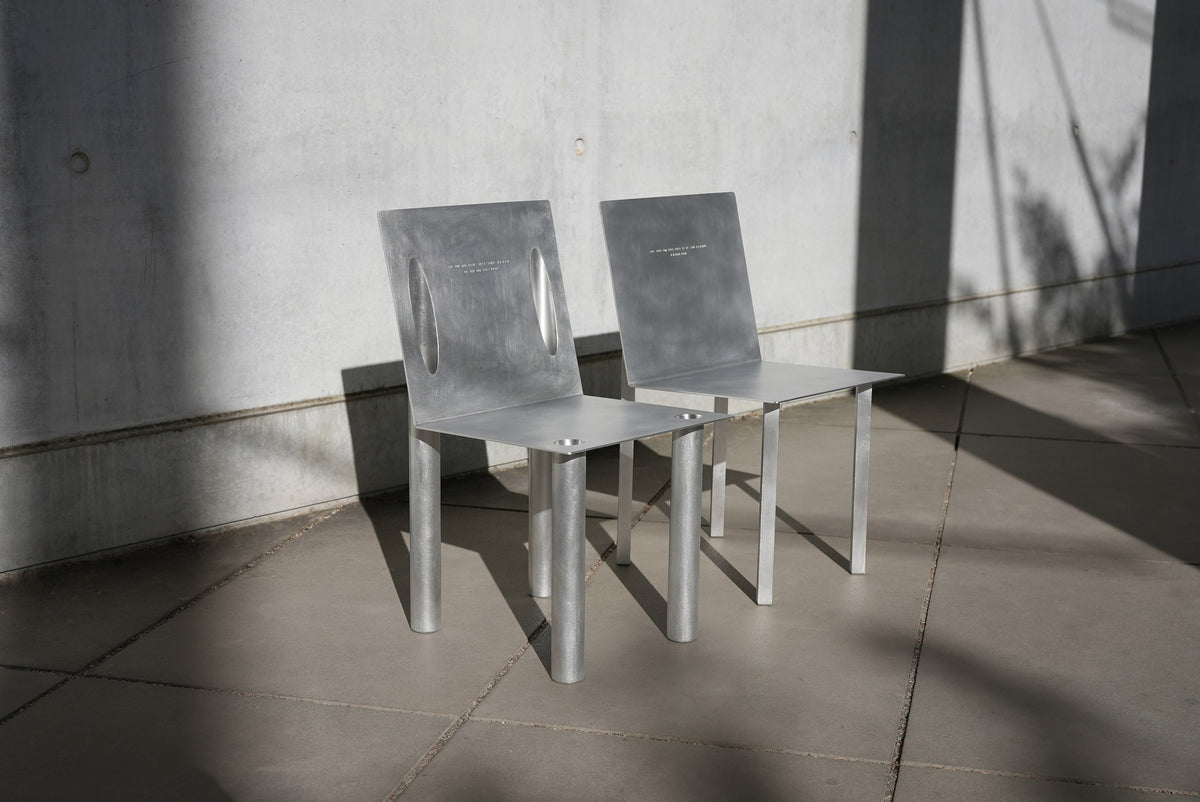
Of everything they have made, Magdalena Shterianova and Johannes von Schoenebeck would probably keep 'Master & Margarita', a pair of chairs in raw aluminium. Mikhail Bulgakov's novel The Master and Margarita is Magdalena's favourite book, and it was one of the first presents she gave Johannes. “So the story has been with us for a long time, and it is closely bound up with our own,” they write. Each of the chairs stands on its own, and the two fit together into one: the Master's square legs slide into Margarita's round, hollow ones.

The two founded Studio von Schoenebeck in Munich in 2023. Johannes trained there as a furniture maker and holds a master's in Design Products from the Royal College of Art in London. Magdalena comes from a film family in Moscow; she studied art history at Ludwig Maximilian University and directed several short films before turning to photography, curation and design. They are a German-Russian-Bulgarian duo and see themselves as a bridge between the cultures of Eastern and Western Europe. “We take up stories and traditions, but also personal memories, and translate them into contemporary objects,” they explain. Their studio is also their flat, under the roof, and by their website's account it is filled with prototypes, maquettes, samples, literature “and many ideas in progress”.
There is no strict division of labour between them. “Ideas mostly come about when we talk things through together,” they say. “Johannes brings in his experience in design, construction and making, while Magdalena particularly enriches the cultural, art-historical and narrative layers. We make the most important decisions together.” In 'Master & Margarita' the construction carries part of the story. “Interestingly, the supposedly masculine Master, with his angular legs, is structurally the more fragile,” they point out, “while the softer, rounder Margarita is the sturdier of the two figures. We like that contradiction, and the idea that strength and vulnerability don't always lie where you'd expect them.” (Readers of the novel won't be surprised: it is Margarita who hosts Satan's ball and gets the Master back.) The chairs, they write, “tell a story about love, opposites and belonging together, and so perhaps a little about ourselves, too”.
The novel is in the metal as well. The aluminium is finished matte by hand and engraved by stencil with lines from the book; on the Master's chair it reads “Who told you that there is no true faithful love”, from the opening of the second part of the novel, the chapter called “Margarita”. The chairs were first shown at 3 Days of Design in Copenhagen in 2025, and in 2026 they won the Design Now award by Interior+Design magazine, in the Art/Design category. They belong to what the studio calls its Literature Collection, and so does 'Traces', six charger plates in stainless steel, finished and engraved the same way.
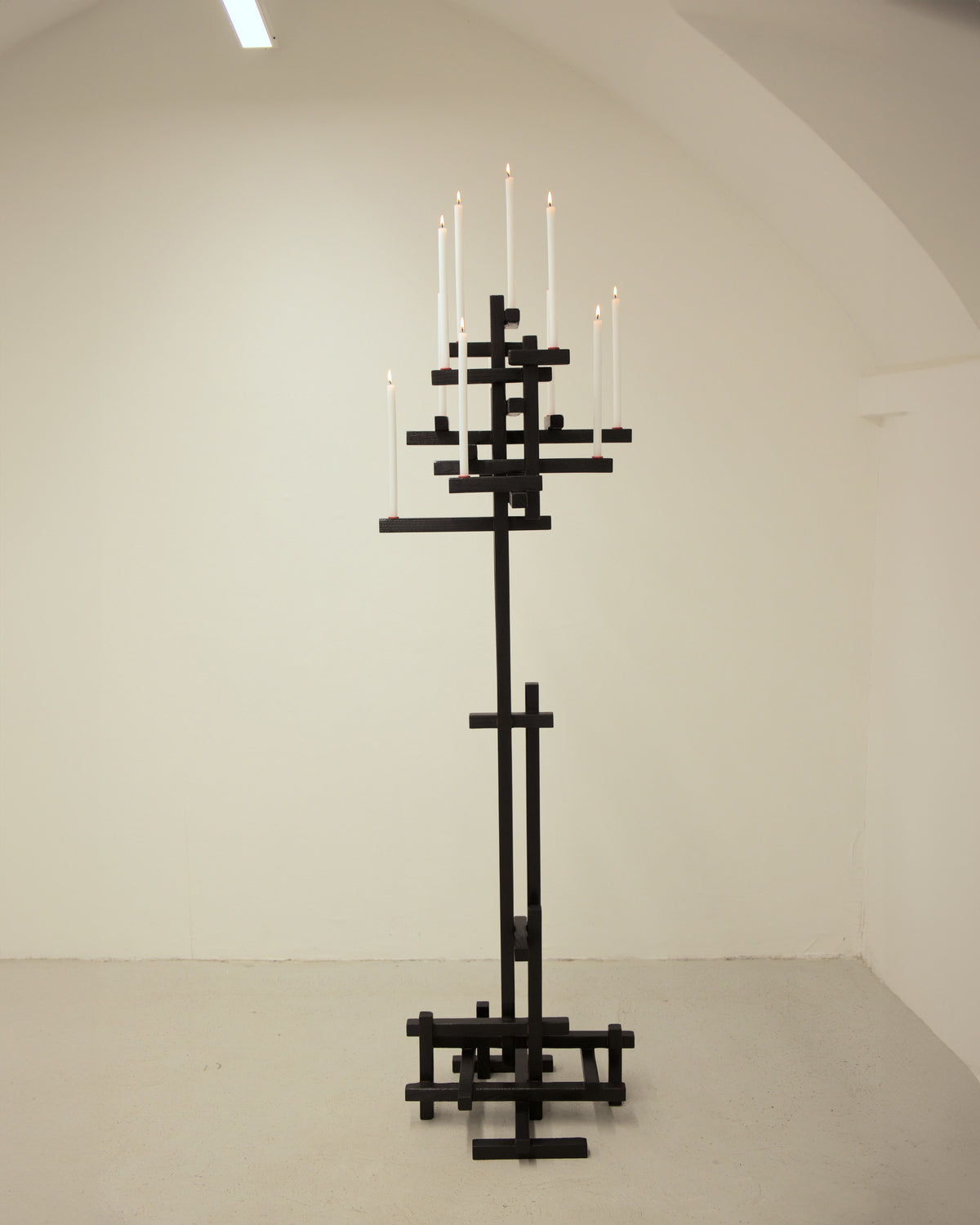
The candle holders in their Fire Collection began at a ball. On the eve of the Kocherlball, the dance in Munich's English Garden that goes back to the city's nineteenth-century cooks and maids, the studio made three rough prototypes from scrap wood. Guests started buying them straight from the table, which led to a first edition. The candles had also left a mark: burning down, they had lightly charred the wood, and the studio kept the effect. 'Tetris' is now made in solid beech and charred on purpose in shou sugi ban, a Japanese technique traditionally used on cedar cladding, in which the burnt surface protects the wood beneath. It comes as holders for three, five or seven candles and as 'Tetris 11', a standing candelabra for eleven. 'Tetris' was shown in Paris during Paris Design Week 2025, and in 2026 at Milan Design Week, in the Brera Design District.

When we asked them in October what they were working on, they named the project that has taken them longer than any other. It has changed enormously since the first drafts, and after many experiments and setbacks, they say, it is finally on the home straight. With it they are pursuing the question of how far the boundaries between design, craft and sculpture can be shifted. “We want to think less about what an object is supposed to be,” they write, “and more about what it can tell, or set in motion.”
Johannes von Schoenebeck and Magdalena Shterianova on 'Master & Margarita'. Photograph: Studio von Schoenebeck.




Mina Wright Came to Clay From Painting, and Named a Vase After a Rococo Dress
Mina Wright came to clay from painting. In Barcelona she builds and paints her vases by hand, and has named one of them after a rococo...

For Valeria Rodríguez Oré of Vale Ro, a Fracture Can Be a Way of Holding
Valeria Rodríguez Oré comes from the Peruvian Amazon and builds vessels by hand in Barcelona. A portrait from the first issue of our magazine.

In Rome, Federica Paglia Makes a Vase with a Door and Boxes That Hold a Chord
A designer in Rome whose vessels are often about the space inside them: a vase whose only opening is a door, and boxes set like a...