
For Valeria Rodríguez Oré of Vale Ro, a Fracture Can Be a Way of Holding

In the short films Valeria Rodríguez Oré makes of her own work, she builds a vessel by hand and then cuts it open. It seems an odd thing to do to a pot, whose whole job is to keep something in, until you read the two sentences with which she introduces 'Anatomy of a Vessel', a body of ceramic work she made between 2022 and 2025: “The fracture becomes a form of holding. The opening becomes a way of containing.” (Anatomy, from the Greek, means cutting up.)

Rodríguez Oré works under the name Vale Ro. She grew up in Iquitos, in the Peruvian Amazon, is based in Barcelona, and draws and paints as well as working in clay. She calls these different paths through one inquiry, into how memory takes shape through matter, and says where she looks for it: in the patterns that recur across living systems, “from rivers and roots to the human body and Amazonian cosmologies.”
She studied business administration, she told the Peruvian newspaper El Comercio in February 2026, and found clay in 2019, when, working in advertising, she walked into a ceramics workshop a couple of blocks from the office. In the same interview she explained why she opens her vessels. In Asian or Greek ceramics, she said, the outside has to be perfect, but what matters in a vessel is that it holds something: water was carried in it, masato, a drink made from cassava, was drunk from it. “That is why I liked the idea of breaking the outer perfection and showing the inside, because that is where things really happen.” She is drawn to vases in particular because they are “a container that contains and is contained at the same time,” and so, she said, is the Amazon, which holds life and is itself held by an immense biodiversity. (She spoke in Spanish; the translation is ours.)
One of those rivers has a name in her work. A vessel of hers is called 'Ucayali'. The Ucayali joins the Marañón in northeastern Peru to form the Amazon. The Shipibo-Konibo people have historically inhabited the Ucayali River basin; they paint and embroider kené, dense geometric patterns of lines, on cloth and pottery. Some of Rodríguez Oré's ceramic surfaces are informed by their traditional kené designs and by her exploration of Amazonian cosmologies, and she has said what she hopes for: “Through my work, I aim to bring greater visibility to their worldview and culture” (Lima Gris, 2024). In 2025 she had a solo exhibition at the Museo del Palacio de Gobierno in Panama City. It was called La memoria del barro, the memory of clay.
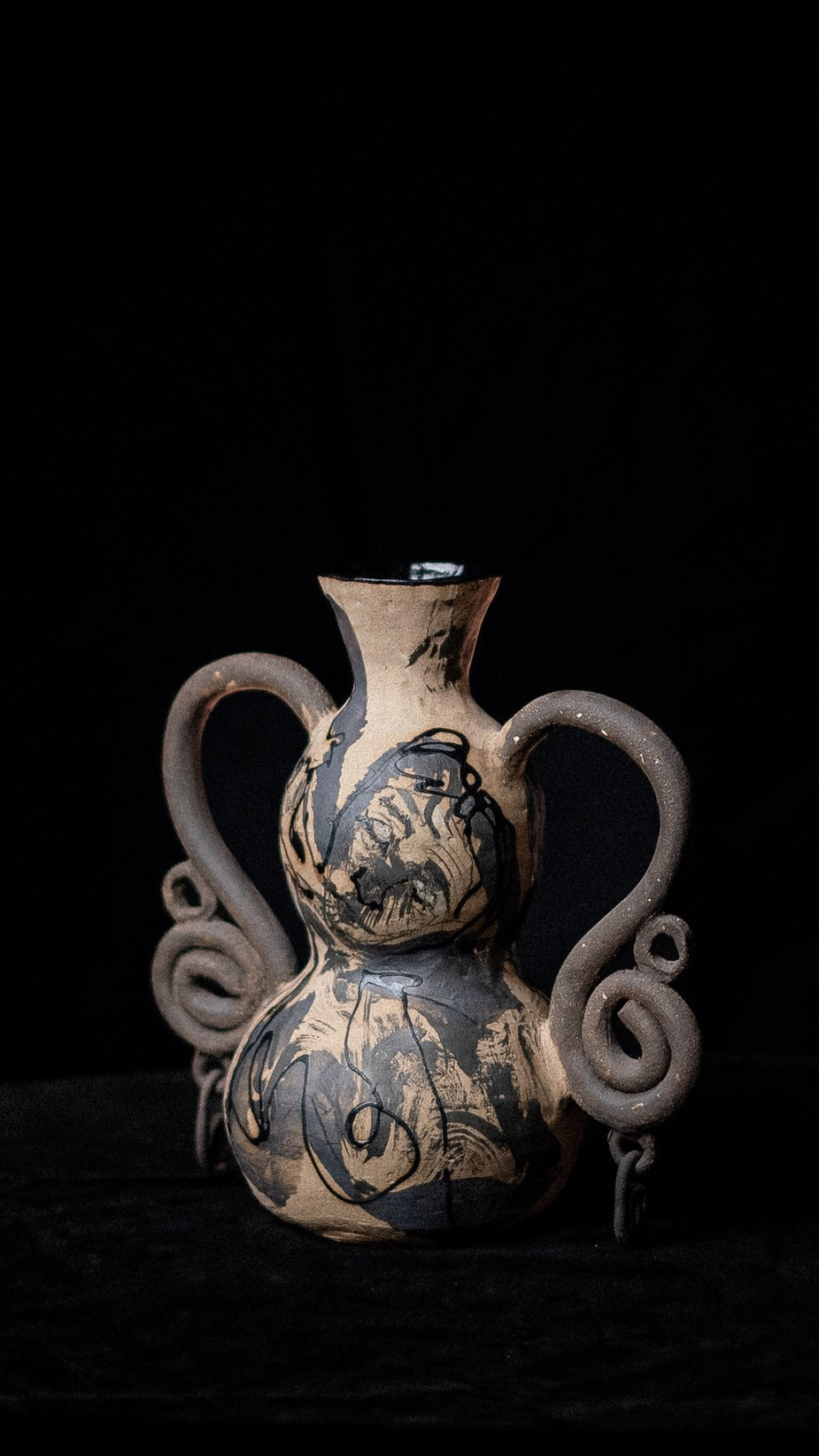
'Anatomy of a Vessel' runs over three series, and the earliest of her pieces on spazio come from the first, 'Territorial Forms', of 2022 and 2023. 'In a Marbling Dream #2' is a vessel with two bellies and coiled handles, built by hand in high-fired clay and marbled in oxides and black glaze. (From the same series we also have 'In a Marbling Dream #3' and 'In a Marbling Dream Candleholder', one of three, each of them unique.)
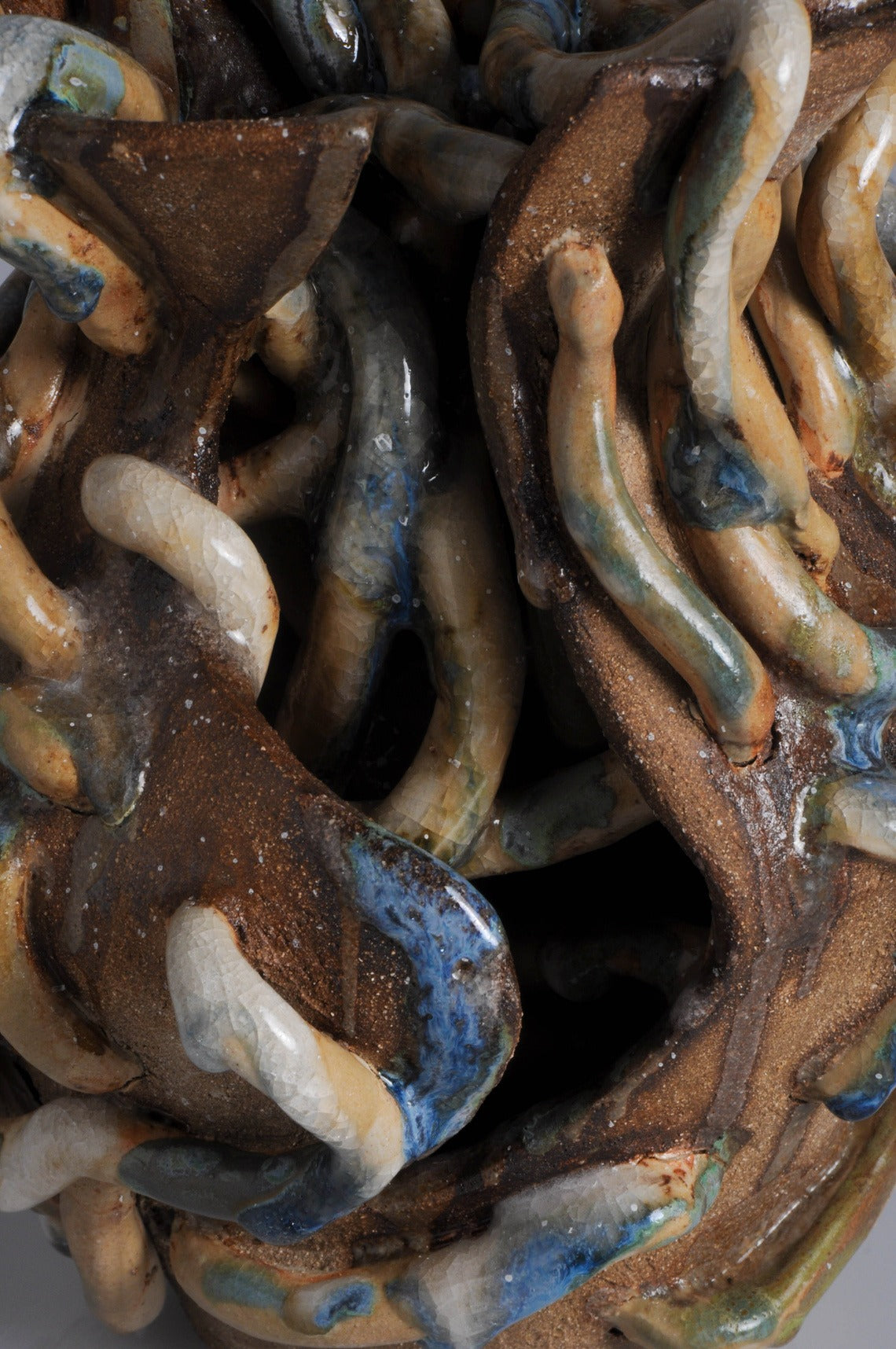
Coiling is one of the oldest ways of building a pot by hand: a rope of clay is laid down ring on ring, and the rings are joined into a wall. 'Tipishka', from 2023, named after a river beach at Iquitos that appears in the low-water season, when the river recedes, is built from coils too, but here they intertwine, and what they make is a sculpture, finished with glazes she formulates herself. It belongs to 'Atravesar', Spanish for to pass through, a series she developed during the postgraduate programme in contemporary applied arts at Escola Massana in Barcelona, and which, as she writes, “explores what it means to move through the intersections of matter, body and perception.” 'Núcleo', from the same year and the same series, is an open, looping form in pale clay. The word is Spanish for nucleus.

In the series that followed, 'Open Vessels' (2024–2025), she takes a traditional vessel and deforms it on purpose, into organic forms after the flow of the Amazonian rivers. She describes the work of 'Anatomy of a Vessel' as built by hand in high-temperature clay and worked with a combination of oxides and glazes she formulates herself. Each of the pieces on spazio is one of a kind. She also works to commission, for collectors, institutions and spaces, and each piece, she writes, “begins with a conversation.”
In 2025 she showed twice with the gallery Adorno: in Copenhagen during 3daysofdesign, in the group exhibition Persona, and in New York during NYCxDESIGN, in Silent Matters, presented as part of Adorno's CHAWAN Collection (a chawan is a Japanese tea bowl). This autumn she wrote to us that she is in the middle of a new series of sculpture. Some of the films she sent show it being made.
Portrait: Stefanny Duarte. Workshop photos: Vale Ro.






In Studio von Schoenebeck's Chairs Named After Bulgakov's Lovers, Margarita Is the Sturdier One
Magdalena Shterianova's favourite novel became a pair of chairs in raw aluminium. How Studio von Schoenebeck in Munich builds its stories into aluminium and charred beech....

Mina Wright Came to Clay From Painting, and Named a Vase After a Rococo Dress
Mina Wright came to clay from painting. In Barcelona she builds and paints her vases by hand, and has named one of them after a rococo...

In Rome, Federica Paglia Makes a Vase with a Door and Boxes That Hold a Chord
A designer in Rome whose vessels are often about the space inside them: a vase whose only opening is a door, and boxes set like a...