
At New Facettes in Berlin, Max Kellermann and Sebastian Labis Make Solid Wood Look Almost Unreal
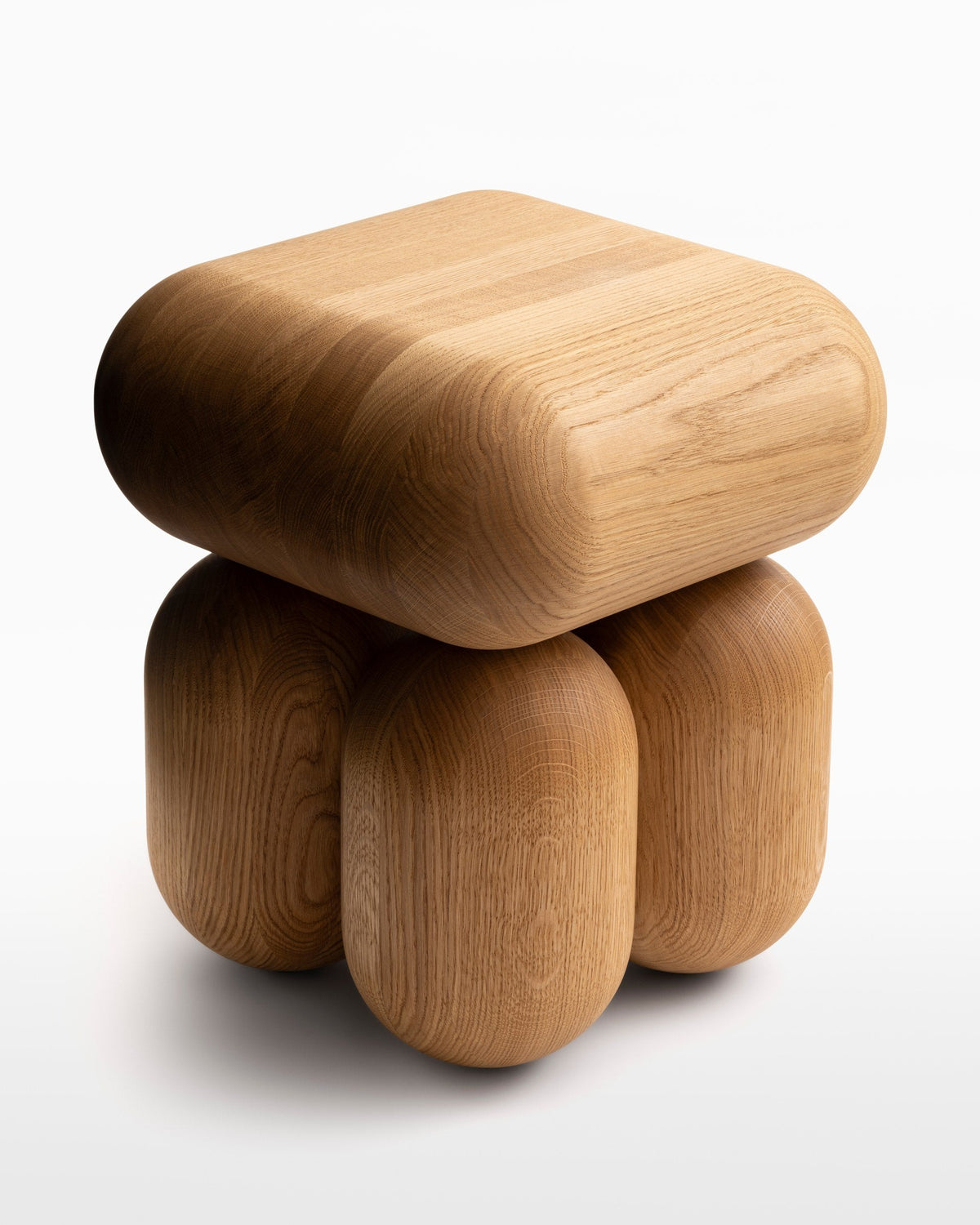
We have looked at a great many photographs of the 'NF1' by now, and in a lot of them the stool could pass for a rendering, with a seat that looks soft enough to sink into. In fact it is solid ash or oak, much heavier than it looks, and the impression is intended. Max Kellermann and Sebastian Labis, who founded New Facettes in Berlin in 2023, write on their website that they aim to create objects “on the threshold between the physical and digital world, making them appear almost unreal.”
Both are architects, and they call New Facettes a young design office. They sum up what it does in one sentence: “With a background in architecture, our focus lies on the creation of long-lasting objects for everyday use, made from renewable resources and produced locally.” Read alongside the line about the unreal, that makes for an unusual brief: things that are built to last and meant to be used every day, and that should still look as if they had not quite arrived in the physical world.
The 'NF1' crosses that threshold in the way it is made. The wood is dried first, because freshly sawn timber keeps moving while it loses its water. It is then planed and glued into blanks for the legs and the seat; a block glued up from dried boards stays steadier than one thick piece would. The legs, which of all its parts look the most like something from a screen, are turned: the blank spins on a lathe against a cutting edge, one of the oldest techniques in woodworking. A lathe makes forms that are round in cross-section, so the seat, a square with softened edges, goes to a CNC mill, whose cutter follows a path calculated from a digital model. The studio's own phrase for this is “combining traditional craftsmanship with modern wood processing techniques.”

After assembly each stool is sanded and finished with natural wood oil, which soaks into the fibres and can be renewed with a fresh coat once the surface has seen some use, and every one is numbered and signed. The seat of each 'NF1' comes from the same digital model, and still the stools differ, because every blank of ash or oak has its own grain; the studio calls every piece it makes unique.
The stool came first. The bench that followed is introduced on the website with “Say hello to NF1B, the exteeended cousin to our beloved stool” (the three e's are theirs). The 'NF1B' is made in the same way, and according to the studio it can be extended to several metres without needing any extra legs. (On spazio, the 'NF1' comes as a stool and as a bench, in ash or in oak.)
In 2023, the year they founded the studio, their work could be seen at VooSpace in Berlin, in Celebrating Berlin Craftsmanship, and later in a furniture display at Studio Schanz in Cologne, in a pop-up shop at Bothi in Amsterdam and, in 2025, in issue 87 of the Berlin magazine Sleek. Each 'NF1' is made individually, to order, and delivered in a wooden crate.
Photographs: 'NF1' by Phillip Koll; workshop courtesy of New Facettes.


In Donostia, Joshua Linacisoro Welds an Incense Holder to Keep His Hands in Practice
Joshua Linacisoro works between Donostia and Barcelona, on objects made for small daily ceremonies. A portrait from the first issue of our magazine.

In Studio von Schoenebeck's Chairs Named After Bulgakov's Lovers, Margarita Is the Sturdier One
Magdalena Shterianova's favourite novel became a pair of chairs in raw aluminium. How Studio von Schoenebeck in Munich builds its stories into aluminium and charred beech....

Mina Wright Came to Clay From Painting, and Named a Vase After a Rococo Dress
Mina Wright came to clay from painting. In Barcelona she builds and paints her vases by hand, and has named one of them after a rococo...